How Much Does Where We Live Shape How We Move?

Notes from the Portland Posture Clinic U.S. Posture Research Project

In 2025, I began a cross-country posture research project for Portland Posture Clinic. The trip was geographic market research: an opportunity to observe posture and movement patterns across different states and regions, collect field observations, and investigate whether Americans appear to use their bodies differently depending on where they live.

The project also supports the development of proprietary educational content for publication and advertising, helps evaluate geographic differences that may eventually inform advertising allocation and other business expenditures, and provides material for public education intended to increase awareness of posture and movement.

This is not a controlled scientific study. I am not randomly sampling residents or measuring every person with instruments. Instead, the project combines direct population observations with existing state-level data, looking for patterns—and, perhaps more importantly, questions worth asking.

One of those questions has become increasingly important:

Does the environment around us help determine the bodies we develop?

What States Spend on Public Recreation

One way to approach that question is to look at how much state and local governments spend on parks and recreation.

According to U.S. Census-derived fiscal-year 2021–22 data, American state and local governments spent approximately $50.8 billion on parks and recreation, or about $153 per resident nationally. North Dakota led the 50 states at approximately $382 per person, followed by Utah at $310, Colorado at $307, Wyoming at $262 and Minnesota at $252. Oregon ranked eighth at approximately $210 per resident.
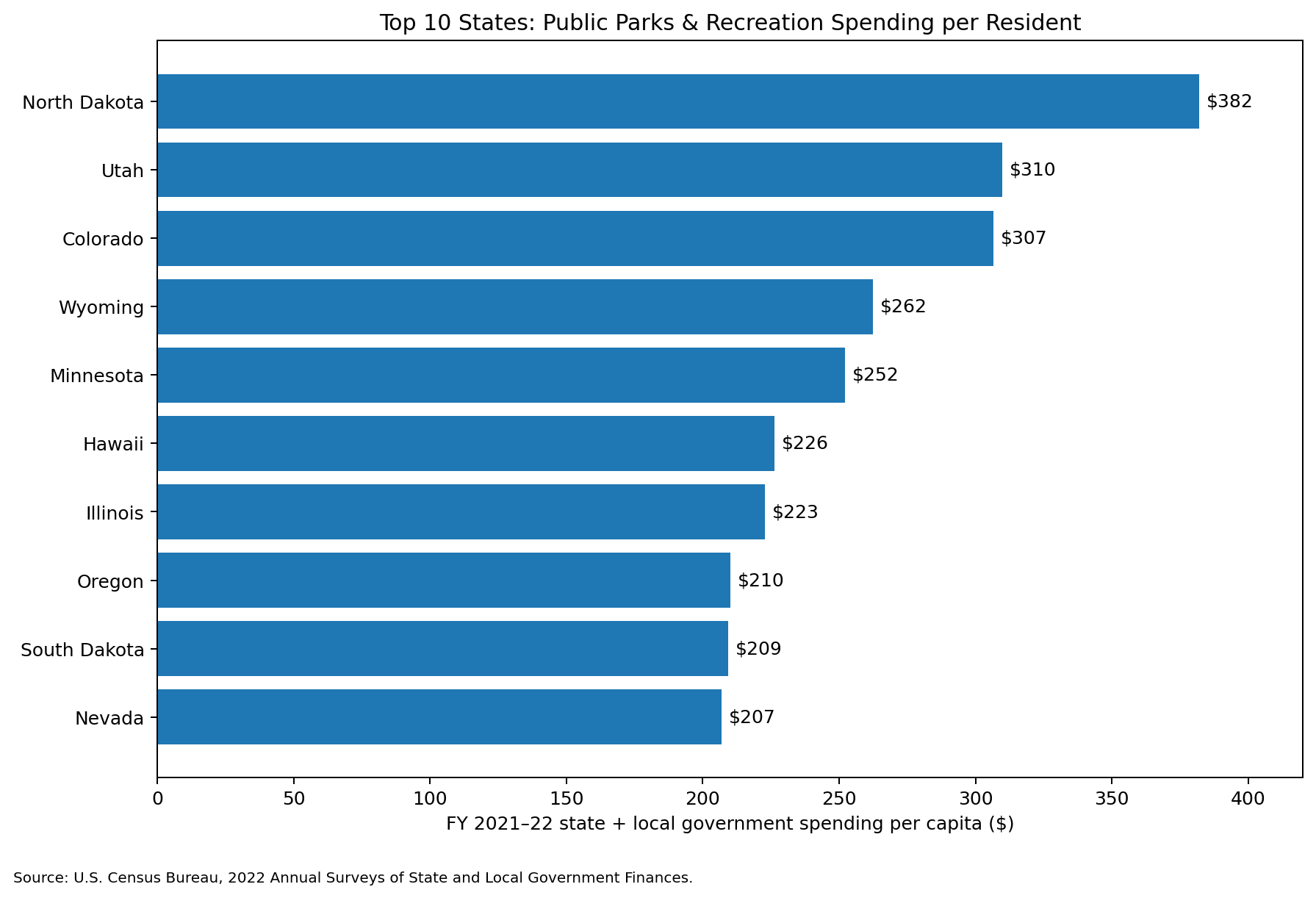
This category should not be mistaken for a pure “fitness budget.” Government parks-and-recreation spending can include parks, athletic fields, swimming pools, recreation facilities and other public amenities, along with some facilities less directly related to exercise.

Still, it gives us something useful: a rough measure of how much public money a state and its local governments devote to environments in which recreation can occur.

And the rankings produce some surprises.

Illinois spends about $223 per person, seventh highest nationally. South Dakota ranks ninth at $209. Yet Vermont spends only about $127, Montana $132, New Hampshire $83 and Massachusetts $83.

If recreation spending alone produced active, adaptable bodies, we might expect those rankings to resemble physical-activity rankings closely.

They don't.

Building a Movement Environment Index

That led me to create a working Movement Environment Index (MEI) for the posture project.

Rather than asking only how much government spends, the MEI asks a broader question:

How strongly does a state's environment appear to support everyday movement?

The current version combines seven factors: access to exercise opportunities, actual participation in aerobic and strength exercise, public parks-and-recreation spending, physical inactivity, automobile dependence, natural-resource investment and federal public-land availability.

Access matters because proximity to parks and recreational facilities is associated with greater opportunities for physical activity. Transportation matters because people who walk, cycle or combine transportation modes generally accumulate more physical activity than people who travel almost exclusively by car.

Exercise behavior matters too. In 2023, only 30.4% of U.S. adults met both the federal aerobic and muscle-strengthening guidelines. Colorado led the states at 35.4%.

The resulting MEI puts Colorado first at 88.8, followed by Oregon at 85.9, Utah at 82.6, Hawaii at 81.9 and Washington at 79.4.
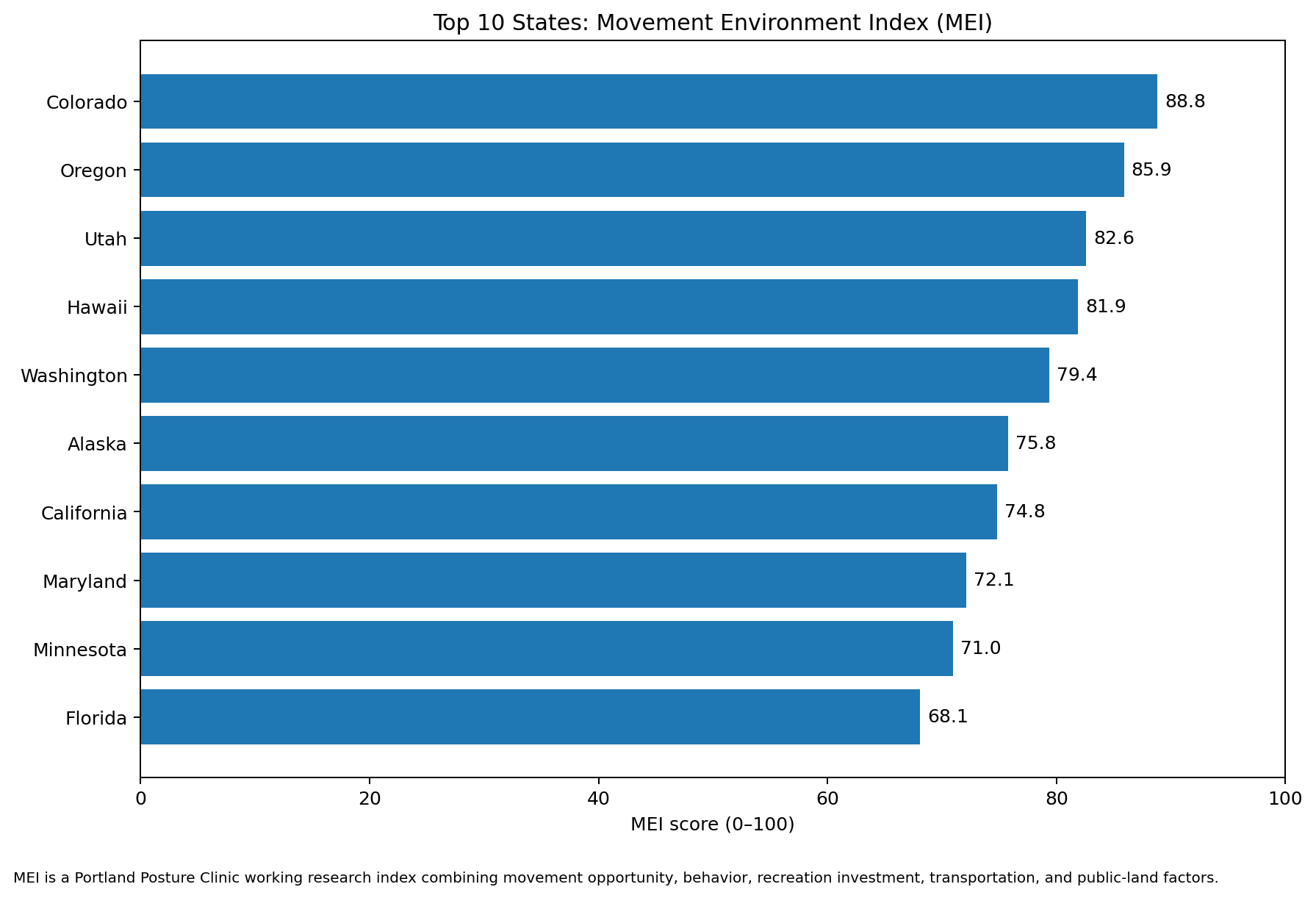
The MEI is not an established public-health statistic. It is a working Portland Posture Clinic research tool designed to organize several potentially relevant environmental variables into one comparison.

And its disagreements with the spending rankings may be more interesting than its agreements.

North Dakota is first in recreation spending but only 25th in the MEI. Illinois is seventh in spending but 18th in MEI. Meanwhile Oregon is eighth in spending but second in MEI.

Montana presents an especially interesting case. It ranks only 28th in recreation spending and 14th in MEI, yet nearly 29% of the state is federally administered land. Oregon is more than 52% federal land and Utah about 63%.

That raises a possibility I became increasingly interested in while traveling:

Formal recreation infrastructure may not be the same thing as a movement-rich environment.

A person in Vermont or Montana may not live near a large municipal recreation center but may regularly hike, ski, work outdoors, carry equipment, climb uneven terrain or move through environments requiring constant small adaptations.

Conversely, someone can live beside an excellent urban park, belong to a gym, and still spend most waking hours seated.

From Movement Quantity to Postural Adaptability

This distinction may ultimately be central to my posture research.

Public spending tells us what communities build.

Exercise statistics tell us something about what residents do.

But posture may also reflect how varied that movement is.

A treadmill provides movement. A rocky trail provides movement plus balance, rotation, visual orientation, foot adaptation and constant adjustments through the hips and trunk.

Likewise, walking several miles through New York is unquestionably movement—but doing it while staring downward at a phone creates a different mechanical environment.

So the question I am pursuing is becoming broader than, “Which state has the best posture?”

It is:

Which environments give people the greatest opportunity to maintain bodies that remain adaptable?

The healthiest posture may ultimately prove to be less about achieving one ideal position and more about retaining the ability to comfortably use many of them.

Sean O'Neill
What Does American Posture Look Like? Notes From an Ongoing 50-State Research Project

For the past several months, I have been thinking about a question that sounds simple until you try to answer it: Where in the United States do people have the best posture?

There is no national posture census. The CDC does not send clinicians around the country measuring forward-head angle, thoracic kyphosis, rib-cage position, pelvic orientation, gait, or scapular mechanics. So this project has required a different approach.

I have been combining available state-level data on physical activity, strength training, inactivity, obesity, demographics, occupation, transportation and lifestyle with what those variables might reasonably imply about musculoskeletal behavior. None of these variables is posture. At best, they provide clues.

I have also been traveling through these states—not as a controlled scientific sample, but as a kind of field anthropology of how Americans inhabit their bodies.

The emerging picture is fascinating.

America Does Not Have One Posture

One of the first conclusions of this project is that talking about “American posture” may be misleading.

The body of someone walking several miles every day in Manhattan is exposed to a completely different environment than someone commuting everywhere by truck in rural South Dakota. A software engineer in Massachusetts may strength-train five days a week but spend another fifty hours sitting at a computer. A rancher in Montana may rarely enter a gym while accumulating enormous amounts of loaded movement.

These lifestyles leave different signatures on the body.

Oregon, which ranked near the top of my initial posture-proxy model, is a good example. Walking around Portland, the population I would expect to see is relatively mobile and recreationally active. There are runners, cyclists, hikers and people who think nothing of walking several miles.

Yet I would not necessarily expect uniformly balanced posture.

The stereotypical Portland body may be active while still displaying the familiar forward head, internally rotated shoulders and relaxed trunk associated with computers, phones and knowledge work. Oregon strikes me as a place where cardiovascular fitness may exceed structural organization.

Drive east into Idaho, and the body seems likely to change. There is more outdoor labor, hunting, construction, agriculture and recreational activity. I would expect somewhat more physical robustness—people who look comfortable carrying things and generating force. At the same time, long drives, machinery and repetitive manual work can produce stiffness rather than ideal alignment.

Then there is Montana.

Of all the states I examined, Montana is one where the distinction between fitness and physical competence becomes particularly interesting. A person who works outside, hikes uneven terrain, carries equipment and spends less of the day folded over a desk may develop something that a posture photograph cannot fully capture: adaptability.

I suspect good posture is less about maintaining one perfect position than possessing many positions.

That idea becomes important as the imaginary trip turns east through South Dakota and into Minnesota.

Minnesota scored surprisingly well in the broader dataset. It has a strong culture of recreation and relatively high physical activity. I would expect to see plenty of sturdy, physically capable people there.

But climate complicates everything. Northern states effectively have two movement environments. Summer invites walking, cycling, sports and outdoor work; winter can mean months of reduced incidental movement. The posture visible in Minneapolis in July may not represent the movement habits accumulated during February.

In Wisconsin, I would expect a similar sturdy Midwestern physicality, but perhaps with somewhat less movement variability. There may be plenty of people who are strong in the conventional sense yet lack thoracic mobility, hip extension or rotational freedom.

This is one of my recurring observations throughout the project: strength alone does not guarantee good posture.

Moving into Illinois makes the urban-versus-state distinction impossible to ignore.

Chicago may be one of America's great accidental posture experiments. People walk. They climb stairs. They stand on trains. They carry bags. Their bodies repeatedly transition between sitting, standing and locomotion.

But Chicago is also filled with office workers staring into laptops.

I can imagine watching commuters pour out of a downtown station: thousands of reasonably fit legs underneath thousands of forward-projecting heads.

That combination may be one of the defining postural signatures of modern America.

Michigan and Ohio raise another issue: the physical legacy of the automobile.

These are states shaped profoundly by driving, manufacturing and suburban development. Long periods in cars combined with increasingly sedentary occupations could plausibly encourage shortened hip flexors, limited hip extension and the familiar head-forward, rib-cage-back sitting posture.

And yet industrial states also contain populations accustomed to real physical work. Again, the averages conceal multiple Americas.

Then comes New York, perhaps the clearest contradiction in the entire project.

If I stood on a Manhattan sidewalk simply watching bodies pass, I suspect I would see enormous amounts of locomotion—and terrible amounts of phone posture.

New Yorkers may walk more than almost anyone else in America while simultaneously spending those walks looking downward.

That produces an interesting question for this research: Can a highly active population still develop poor upper-body posture because of technology?

I strongly suspect the answer is yes.

In Massachusetts, particularly around Boston, another paradox appears. The population is relatively healthy and fitness-conscious, but the state also has an enormous concentration of academics, physicians, researchers, programmers and other professionals whose work occurs in front of screens.

I would expect to see people who exercise deliberately because their occupations require so little movement.

That is different from simply being physically active throughout the day.

Travel north into New Hampshire and Vermont, and my expectations shift again. Both ranked very highly in the posture proxy. Hiking, skiing, outdoor recreation and lower inactivity rates probably matter. Vermont especially makes me wonder whether routine exposure to irregular terrain is an overlooked posture variable.

Walking on a treadmill is repetitive.

Walking through woods is a neurological problem.

Every rock, root, slope and change in grade requires subtle adjustments through the feet, hips, trunk and vestibular system. A population that regularly moves through complex terrain may acquire a kind of postural intelligence that ordinary fitness statistics miss.

And that may ultimately be where this project is heading.

The question is not necessarily which state stands up straightest.

But instead:

Which environments produce Americans whose bodies remain the most adaptable?

The early rankings put Colorado, Alaska, Utah, Vermont and Montana near the top, with states such as Mississippi, Oklahoma and West Virginia near the bottom. But those rankings are proxies, not verdicts.

As this research continues, I am becoming less interested in whether someone's ears sit perfectly over their shoulders and more interested in something broader.

Can they squat?

Can they rotate?

Can they comfortably look behind them?

Can they walk several miles?

Can they carry something heavy?

Can they sit on the ground and get back up?

Can they stand for an hour without constantly searching for support?

And, perhaps most importantly, can their posture change when the situation demands it?

That may be the real American posture question.

We may eventually discover that the healthiest posture isn't a position at all.

**It is a body that still has options. **

Sean O'Neill
Car Accident Rehabilitation with Posture Therapy

HOW POSTURE CAN FIX YOUR BACK

 Joe was in a car accident.  As a result he had debilitating back pain.  After trying, what seemed like, everything over a 12 year period, he came across the posture approach to chronic pain. By treating a person’s entire posture rather than a specific condition or symptom.  The method views the body as a unit, treating it as such.  When troubleshooting the body as a whole, imbalances and compensations can be eliminated.  After a trauma like a car accident, the body reacts by making many little changes as it reacts to the sudden impact it endured, which can lead to dysfunction in the musculoskeletal system.  Does your back hurt on a daily basis?  Perhaps your hips are rotated.  Maybe your hip flexors are dysfunctional. Do you have a recurring ankle injury?  Why is it in only one ankle?  Both ankles are the same age.  Perhaps there is a discrepancy in the workload placed on your hips.  Do you arms swing when you walk?  Does one of your knees turn inward?  Outward? There are many examples of posture imbalances that we observe at PortlandPostureClinic.com.  With a quick and FREE online assessment, we can determine a corrective exercise regiment specific to your posture.  Take control of your back pain by restoring your body’s intended postural design.  Portland Posture Clinic conducts virtual sessions and using proprietary posture analysis software, providing a personalized exercise menu that includes detailed video and picture instructions delivered directly to a phone app and email after every online visit.  Perhaps you’ve had trouble turning a corner after a car accident that caused chronic back pain, or you’re struggling to get over the hump after an automobile collision that lead to a neck injury, headaches, or trouble sleeping.  Begin your free assessment at PortlandPostureClinic.com today.  Take control of you pain. 

Keywords: Egoscue, Portland, Posture, Pain Free, Corrective Exercise, Back Pain

Your Body is the Brace, Don’t Let It Forget

THE BODY’S INTENDED POSTURE

There are many products in the health and fitness world that brace, stabilize, and stimulate your body in order to compensate for dysfunction and imbalance.  However, what assistive products do, is train your body to rely on external support when, in fact, the musculoskeletal system is intended to serve you in all these capacities without assistance.  When you wear an ankle or knee brace, you weaken the knee and ankle and create a reliance on the external support.  Alternatively, if you train your body to harness it’s intended functionality, you can create a system of stability and integrity that will move and support you.  Our species has not come this far because of special tapes and gadgets.  We are built to endure and the body will repair itself if given the chance.  At PortlandPostureClinic.com we provide specific corrective exercise to alleviate pain and improve performance by giving your body the chance to regain its intended functionality.  You can get a free online posture assessment in a few easy steps and PortlandPostureClinic.com.

Keywords: Egoscue, Portland, Posture, Pain Free, Corrective Exercise, Back Pain

Sean O'Neill
Posture and Inflammation

JOINT POSITION AND CORRECTIVE EXERCISE THERAPY

The suffix -itis means inflammation.  Add it to a body part and it means there’s inflammation in that area.  Appendicitis means inflammation relating to the appendix.  Tendonitis means inflammation relating to a tendon.  Arthritis means inflammation relating to a joint.  Inflammation is a condition that occurs due to stress and irritation.  With regards to the musculoskeletal system, improper joint position creates friction in the joint, which causes inflammation; therefore, reducing friction, reduces inflammation, reducing pain and injury.  PortlandPostureClinic.com treats posture with corrective exercise to reduce this friction and reduce inflammation, in turn, reducing pain.  In a few easy steps you can get a free posture assessment at PortlandPostureClinic.com and begin to address your posture and eliminate your pain, improve athleticism, and return to your favorite physical activities pain free.  PortlandPostureClinic.com treats people virtually, so no matter where you are in the world, you can pursue a pain free life through corrective exercise using the Egoscue Method.  Each session includes a personalized exercise menu with detailed video, picture and written instructions.   

Keywords: Egoscue, Portland, Posture, Pain Free, Corrective Exercise, Chronic Pain, Back Pain

Treat Your Posture, Treat Your Pain

ONLINE POSTURE THERAPY

The COVID-19 pandemic has intensified our reliance on technology, urging the clinical process to take place remotely.  PortlandPostureClinic.com provides remote posture correction sessions, utilizing posture analysis software that provides detailed video, picture, and written exercise instructions to your email and phone app.  In-home virtual sessions help clients establish workout routines at home, encouraging healthy habits and routines that lead to a pain free life by correcting posture. 

PortlandPostureClinic.com specializes in the Egoscue Method, helping people with a litany of physical problems that can be traced back to posture imbalances: chronic back pain, knee pain, shoulder pain, scoliosis, wrist pain, hand pain, foot pain, tendonitis, neuropathy, migraine headaches, TMJ, flat feet, tinnitus, and neck pain. 

No matter where you live, PortlandPostureClinic.com is available to help reduce your chronic pain by addressing your posture through corrective exercise. 

PortlandPostureClinic.com offers a free online posture assessment via their website.   

Keywords: Egoscue, Portland, Posture, Pain Free, Corrective Exercise, Chronic Pain, Back Pain   

Sean O'Neill